

Bearings for Robotics
Robot joints demand maximum load capacity and positioning accuracy within the tightest possible envelope. As humanoid robots, collaborative robots, SCARA systems, and AGV/AMR platforms push toward lighter frames and more compact architectures, bearing selection becomes a critical design constraint — every millimeter of cross-section and every gram of weight matters at the joint level.
BOM manufactures high-precision crossed roller bearings, harmonic reducer bearings, and flexible bearings engineered specifically for robotic joint and reducer applications. With full-spectrum custom manufacturing capability — including gear-bearing integration, flange-integrated structures, and waterproof configurations — BOM delivers solutions where standard catalog bearings fall short:
- Compact cross-section and lightweight design for space-critical joints
- High moment rigidity and rotational accuracy in a single bearing row
- Gear-bearing integration — gear teeth machined directly on the bearing ring
- Full complement or spacer/cage internal configurations available
- Precision grades up to P4 for high-accuracy applications
- Full-specification custom manufacturing — dimensions, materials, coatings, and bearing structure
Compact & Lightweight Design
Every robot joint competes for space and weight budget — especially in humanoid and quadruped robots where dozens of actuated joints share a limited payload envelope. BOM manufactures ultra-thin crossed roller bearings and slim flexible bearings that deliver multi-directional load support within minimal radial and axial cross-sections, reducing joint weight and lowering motor torque demands across the entire kinematic chain.
Custom Integration
Inside harmonic and planetary reducers, the fit between gear and bearing directly determines output precision and structural strength. BOM manufactures gear-integrated bearings — gear teeth machined directly onto the bearing ring as a single component — eliminating assembly tolerance stack-up and improving torque transmission rigidity. Flange-integrated structures and waterproof sealing configurations are also available for outdoor AGV and quadruped robot applications.
Precision & Rigidity
Robotic joints require exceptional rotational accuracy and moment stiffness to maintain positioning repeatability under dynamic loads. BOM’s crossed roller bearings achieve this by arranging cylindrical rollers in an alternating 90° crossed pattern — each roller supports radial, axial, and moment loads simultaneously, delivering the rigidity of a multi-row arrangement within a single compact row. Precision grades up to P4 are available for high-accuracy applications.
BOM Products for Robotics
Crossed Roller Bearings
Standard and slim-type crossed roller bearings for robot joint rotary support. High moment rigidity and rotational accuracy in a single-row compact cross-section.
View Product Details →Slim Crossed Roller Bearings
Ultra-thin wall crossed roller bearings for weight-critical joints — humanoid robot limbs, wrist axes, and compact actuator modules.
View Product Details →Harmonic Reducer Bearings
Precision bearings for harmonic drive output shafts — crossed roller or four-point contact configurations matched to harmonic reducer dimensional standards.
View Product Details →Flexible Bearings
Thin-wall flexible bearings for the wave generator position inside harmonic reducers, designed to accommodate the elliptical deformation cycle of the flexspline.
View Product Details →Application Cases
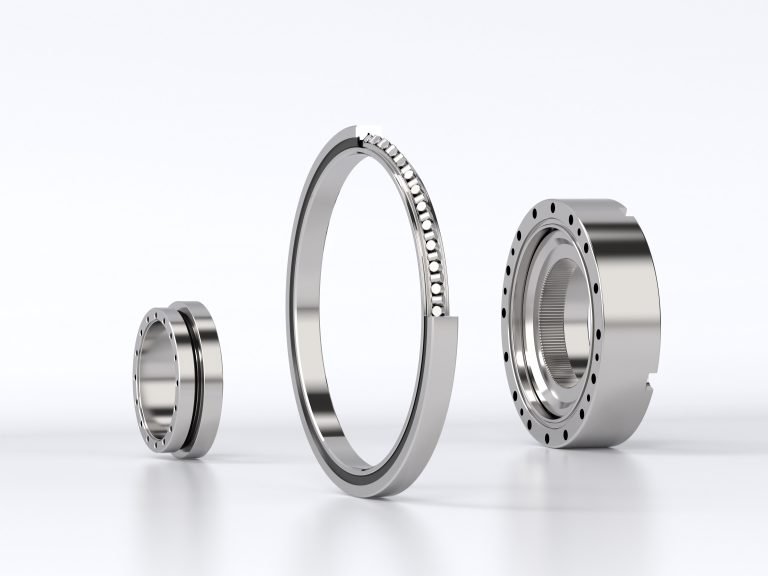
Slim Crossed Roller Bearings — Humanoid Robots & Quadruped Robots
Humanoid and quadruped robots require each joint to deliver high load capacity and rotational precision within an extremely compact envelope. BOM’s slim crossed roller bearings feature an ultra-thin wall cross-section that fits into the tightest joint housings while still supporting radial, axial, and moment loads simultaneously through the crossed 90° roller arrangement.
By minimizing bearing cross-section height and weight, these bearings help reduce overall joint size and mass — directly lowering motor torque requirements and improving the robot’s payload-to-weight ratio. The high rotational accuracy ensures precise, repeatable positioning at every joint, which is critical for stable locomotion in quadruped platforms and coordinated limb movement in humanoid systems. Currently in use by China’s top 2 humanoid robot manufacturers and top 2 quadruped robot companies.
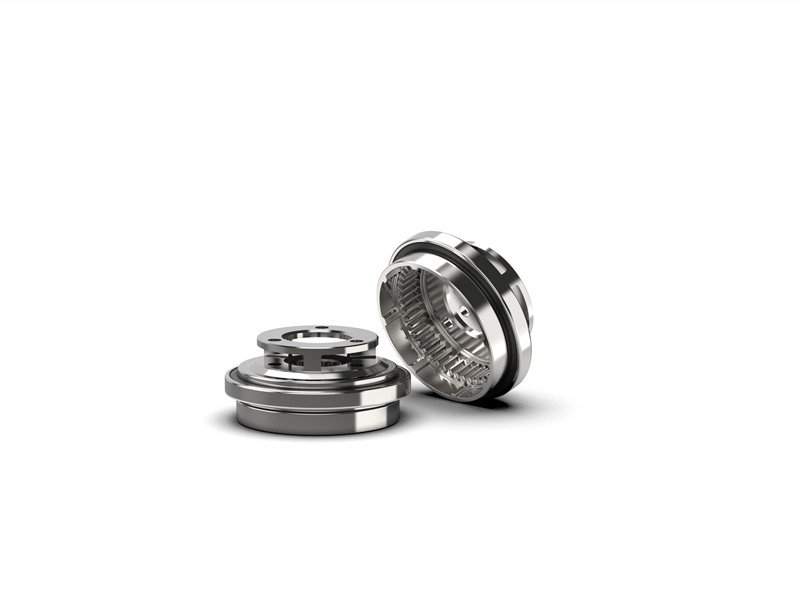
Gear-Integrated Crossed Roller Bearings — Harmonic & Planetary Reducers
In conventional harmonic and planetary reducers, the output gear and the output bearing are separate components — pressed or bolted together during assembly. This introduces tolerance stack-up between the gear and bearing, which directly limits the achievable output precision and structural rigidity of the reducer.
BOM’s gear-integrated crossed roller bearings solve this by machining the gear teeth directly onto the bearing outer ring as a single one-piece component. Eliminating the gear-bearing interface removes the primary source of assembly error, significantly improving output positioning accuracy and torque transmission stiffness. The integrated structure also reduces part count, simplifies assembly, and creates a more rigid load path from the gear mesh through to the bearing raceway — resulting in a more compact and reliable reducer module for robotic joint applications.
Bearings for Robotics: Why Choose BOM?
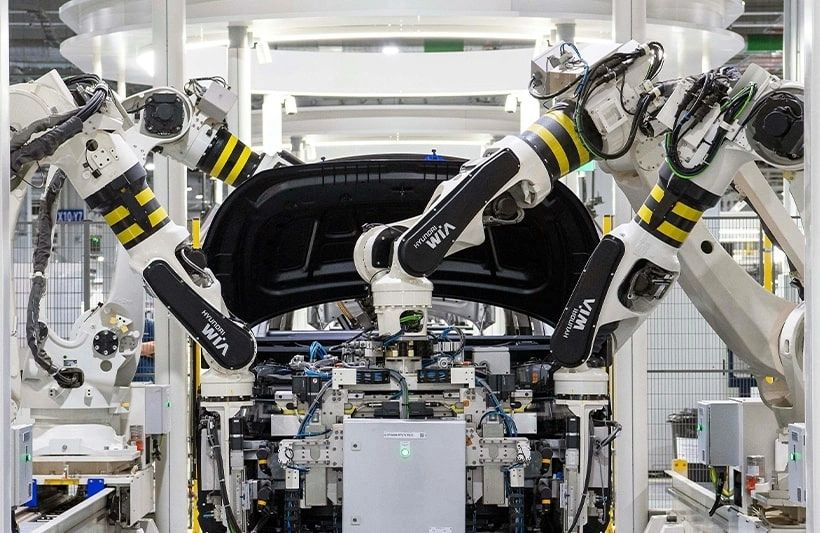
Trusted by Leading Robotics Manufacturers
BOM Bearing is a professional manufacturer of precision bearings for robotics and motion control applications. Trusted by China’s top 2 humanoid robot manufacturers, top 2 quadruped robot companies, and Japanese SCARA system builders, BOM delivers customized bearing solutions engineered for the most demanding robotic joint and reducer applications.
ISO 9001, IATF 16949, and ISO 14001 certified — quality and environmental standards validated at every production stage. Full-specification customization from non-standard dimensions and alternative materials to specialized coatings and complete bearing architecture redesign — engineered to your exact requirement.
Frequently Asked Questions
Crossed roller bearing vs angular contact bearing vs four-point contact bearing — how to choose for robot joints?
Crossed roller bearings arrange cylindrical rollers in an alternating 90° pattern, providing high moment rigidity and rotational accuracy in a single compact row — the default choice for most robotic joints where space and stiffness are critical. Angular contact ball bearings offer higher speed and lower friction but require paired mounting to handle combined loads, increasing axial stack length. Four-point contact ball bearings handle combined loads in a single row like crossed rollers, but with lower rigidity due to point contact. For most robotic joints, crossed roller bearings provide the best balance of compactness, rigidity, and precision.
What is the difference between full complement and spacer-type crossed roller bearings?
In a full complement design, all positions between the rings are filled with rollers — no separating elements — maximizing load capacity at the cost of higher friction. In a spacer-type (also called cage-type or retainer-type) design, polymer or metal spacers between adjacent rollers prevent direct roller-to-roller contact, significantly reducing friction and torque resistance for smoother rotation. Full complement suits high-load, low-speed applications; spacer-type suits robot joints requiring low starting torque and consistent motion quality. BOM manufactures both configurations.
What bearings are used inside harmonic and planetary reducers for robots?
Harmonic reducers use a thin-wall flexible bearing inside the wave generator and a crossed roller or four-point contact bearing at the output stage. Planetary reducers typically use crossed roller or cylindrical roller bearings at the output shaft. BOM manufactures both flexible bearings and output-stage bearings matched to standard harmonic and planetary reducer dimensional envelopes, with custom configurations available for proprietary reducer designs.
Can BOM manufacture gear-integrated and flange-integrated bearings for robotic applications?
Yes. BOM manufactures integrated bearing assemblies where gear teeth or flange mounting features are machined directly onto the bearing ring as a single one-piece component. Gear-bearing integration eliminates tolerance stack-up, improving output precision and structural rigidity. Flange-integrated bearings simplify assembly by combining the bearing and its mounting interface into one part. Waterproof sealing structures are also available for outdoor robots, AGVs, and quadruped platforms.
What precision grades and customization options are available for robotic crossed roller bearings?
BOM manufactures crossed roller bearings in precision grades P5 and P4 for robotic applications. Beyond standard grades, BOM offers full-specification custom manufacturing — non-standard dimensions, alternative materials, specialized coatings, and complete bearing architecture redesign including gear-integrated, flange-integrated, and waterproof configurations. Contact our engineering team for a customized recommendation.
Industry
Speak To One of Our Experts
Name can't be empty
Email error!
Message can't be empty
Send message
*We respect your confidentiality and all information are protected.
People Also Viewed of
-
 Bicycle
Our bearing solutions enable manufacturers to create lighter, more compact E-bikes through innovative design. With our proprietary technology, we deliver customized bearings featuring enhanced load capacity and superior water resistance...
View All -
 Reducer
In the core of every efficient robotic joint and automated drive system lies a critical component: the reducer. It is the definitive element that converts high-speed motor input into controlled, high-torque output...
View All -
 Automated warehousing
Smart Warehousing Modern automated warehousing demands uncompromising reliability in continuous operation cycles. Our innovative solutions deliver superior assembly precision that ensures exact...
View All


