

Special Bearings


Gear Integrated Bearing
Flange-integrated bearings combine the flange and the bearing outer ring into a single integrated structure.
In this design, the flange acts as the mounting and positioning reference, eliminating outer ring press-fitting and improving compactness, assembly consistency, and operating stability.
This structure can be applied to various bearing types, such as deep groove ball bearings and crossed roller bearings, and can be tailored to different precision and load requirements.
Key Features
-
Integrated Outer Ring and Flange Design
-
Compact Structure and Easy Installation
-
High Rigidity and Mounting Accuracy
-
Applicable to Multiple Bearing Types
Product Inquiry
Product Category
Speak To One of Our Experts
Name can't be empty
Email error!
Message can't be empty
Send message
*We respect your confidentiality and all information are protected.
Description
Reviews
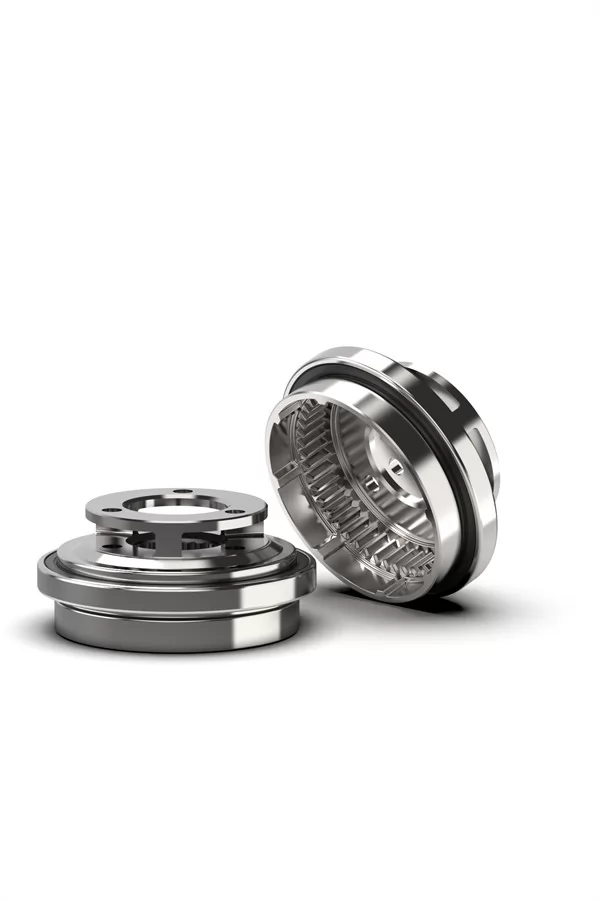
Gear Integrated Bearing
Customizable 30%+ Load Increase High Precision
A gear integrated bearing (also called a gear ring bearing) is a custom-engineered unit in which an internal or external gear ring is machined directly into the bearing inner or outer ring — eliminating the separate gear ring component, removing assembly tolerance stack-up, and enabling larger rolling elements for 30% or more higher load capacity than a conventional bearing-plus-gear-ring assembly.
- Integration: Internal or external gear ring machined into bearing inner/outer ring
- Load Gain: ≥30% higher dynamic load rating vs. conventional assembly
- Concentricity: Gear ring and raceway machined in the same setup — zero press-fit error
- Gear Options: Internal gear / external gear — custom module, tooth count, and profile
- Applications: Robotics, planetary gearboxes, harmonic drives, and precision reducers
Addressing Problems
In applications where a bearing must also serve as the interface for gear transmission — such as robot joints, planetary gearboxes, and harmonic drives — the conventional approach is to press-fit a separate gear ring onto the bearing inner or outer ring. This creates a layered assembly with compounding tolerance errors, unnecessary bulk, and structural limitations that reduce both precision and load capacity. Our gear integrated bearing eliminates these layers by design.
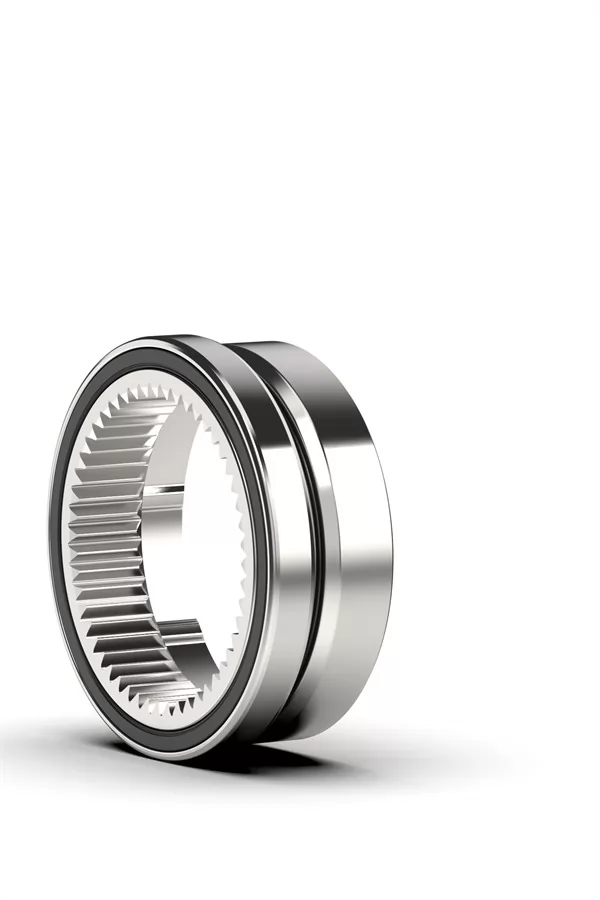
Precision Lost in Assembly
The gear integrated bearing eliminates the press-fit interface entirely: the gear teeth and bearing raceway are machined in a single clamping setup from the same ring blank. This means the gear ring and rolling track share a common axis by definition — achieving concentricity that is physically impossible to replicate through press-fitting, and delivering the transmission accuracy that precision drives demand.
When a gear ring is press-fitted onto a bearing ring, the manufacturing tolerances of both parts stack up. Even a small eccentricity between the gear ring center and the bearing axis introduces transmission error and vibration — critical problems in robotics and precision gearboxes where position accuracy is measured in arc-minutes.
Every Separate Part Adds Size and Weight
By integrating the gear ring into the bearing ring, we eliminate one complete component from the assembly. The gear teeth occupy space that was previously shared between the bearing ring wall and the gear ring wall — resulting in a combined unit that is measurably shorter in the axial direction and lighter overall. In robot joints and harmonic drive assemblies where every gram and millimeter counts, this reduction matters.
A conventional arrangement places the gear ring as an independent component on the outside of the bearing, adding to both the radial and axial footprint of the assembly. In compact structures like robotic wrists and multi-stage planetary gearboxes, this extra bulk constrains the design and limits the performance achievable within the available envelope.
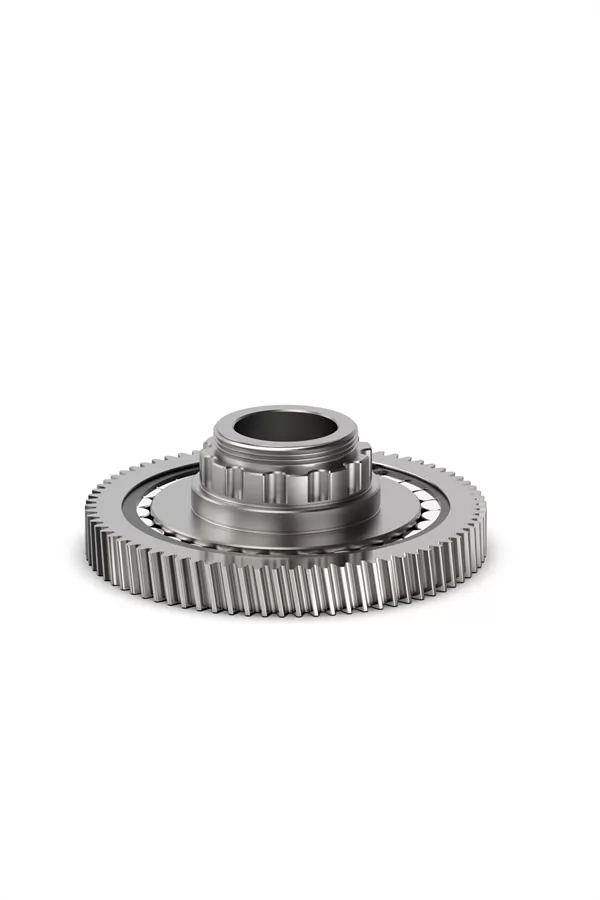
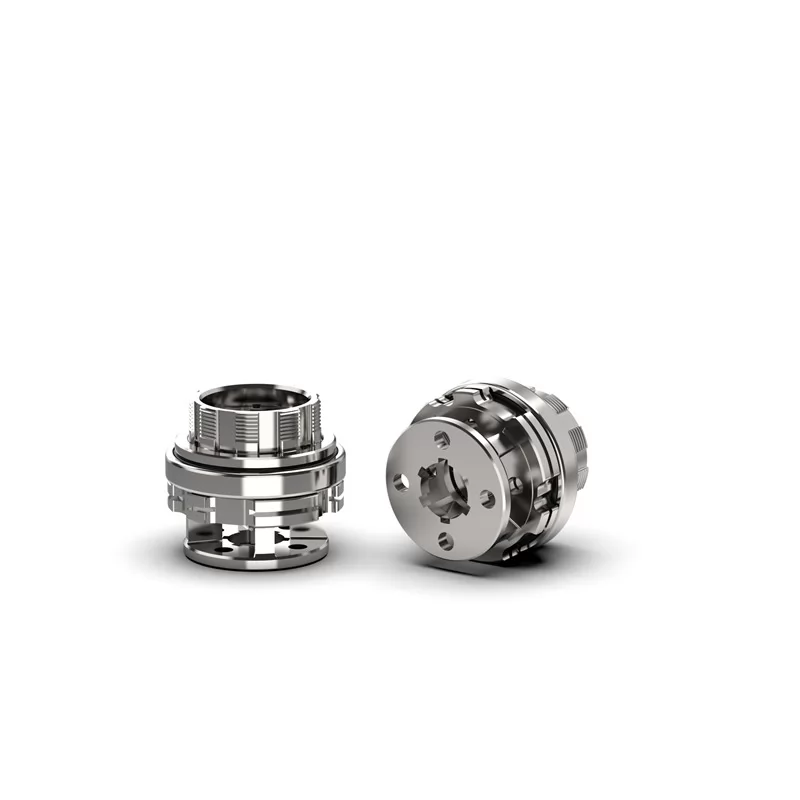
Load Limited by Standard Wall Thickness
Without the constraint of a separate gear ring pressed over the bearing ring, we are free to design the bearing ring wall to the optimal thickness for the application — and to select larger rolling elements accordingly. The result is a ≥30% increase in dynamic load rating within the same outer dimensional envelope, directly extending service life and supporting higher torque transmission in planetary and harmonic drive systems.
Standard bearings used in gear drive applications must accommodate a press-fitted gear ring on the outer surface. This constrains the available ring wall thickness, which in turn limits the maximum rolling element diameter and the achievable load rating. Engineers are forced to accept the catalog performance ceiling or move to a larger, heavier bearing series.
Applications
Industrial Robotics
Robot joints require high transmission precision and compact, lightweight construction. The gear integrated bearing eliminates eccentricity between the drive gear and bearing axis — reducing vibration, improving positioning repeatability, and reducing the joint weight budget for the same torque output.
Planetary Gearboxes
Planetary reducers rely on an internal ring gear (annulus) to guide planet gears. Integrating this ring gear directly into the outer bearing ring ensures the planet gear orbits share a true common axis with the output shaft bearing — improving load sharing and reducing noise at the gear mesh.
Harmonic & Strain Wave Drives
Harmonic drives require extreme concentricity between the flex spline, circular spline, and supporting bearing. A gear integrated bearing reduces the number of concentric interfaces in the assembly — directly improving angular positioning accuracy and reducing the accumulated error that limits drive resolution.
Precision Transmission Mechanisms
Wherever a bearing supports a shaft that also carries a gear — in machine tools, rotary tables, or multi-axis motion systems — integrating the gear into the bearing ring reduces component count, eliminates press-fit eccentricity, and enables a more rigid, compact, and accurate power transmission structure.
About BOM Bearing
BOM Bearing designs and manufactures custom-integrated bearing solutions for applications where standard bearings reach their limits. Certified to ISO 9001, IATF 16949, and ISO 14001, we apply automotive-grade manufacturing discipline to every custom component we engineer.
- Certified to Automotive Standards: ISO 9001, IATF 16949, and ISO 14001 — the quality management system demanded by global automotive supply chains, applied to every custom bearing we manufacture
- Engineering from Your Requirements: Share your current bearing setup and performance targets; our engineering team designs a custom-integrated solution to your exact specifications
- Technical Partnership: End-to-end engineering support — from analysis of your existing assembly to design, prototyping, and production of the integrated solution
- Trusted by Industry Leaders: Custom integrated bearings adopted by global market leaders in embroidery machinery, packaging equipment, and industrial automation
_1770101839_WNo_400d600.webp)
Frequently Asked Questions (FAQ)
Can you integrate both internal and external gear rings into a bearing?
Yes. We support internal gear rings (machined into the bearing outer ring, functioning as an annulus gear) and external gear rings (machined into the bearing inner or outer ring, functioning as a pinion interface). Custom module, tooth count, tooth profile, and gear accuracy grade can all be specified to match your transmission requirements.
How much more precise is the integrated design compared to press-fitting a gear ring?
Press-fitting a gear ring onto a bearing inevitably introduces eccentricity between the gear ring center and the bearing axis — typically in the range of several micrometers to tens of micrometers depending on fit tolerances. The integrated design machines both features in a single setup, making concentricity error a function of machine tool accuracy rather than assembly tolerance stack-up — typically an order-of-magnitude improvement.
What gear accuracy grades can you achieve?
Achievable gear accuracy grade depends on the specific gear geometry and materials. Please contact us with your requirements — including module, pitch diameter, and required accuracy class (ISO or DIN) — and our engineering team will confirm feasibility and provide a detailed quotation.
What performance advantages does integration deliver beyond concentricity?
Three compounding advantages: first, eliminating the press-fit interface removes eccentricity error at its source, giving you cleaner gear mesh and quieter transmission. Second, the freed ring wall thickness lets us fit larger rolling elements, raising load rating by 30% or more within the same envelope. Third, fewer components means fewer assembly variables — every unit leaves our facility with the same concentricity performance, batch after batch. The combined effect is a drivetrain that is more precise, more capable, and more consistent than the conventional bearing-plus-gear-ring arrangement.
0 Comments
Share your thoughts
Showing 6
of 0
reviews
Your rating
Your review *
Your Name *
Enter your Name
Your Email *
Enter your Email
Submit
Contact Us
Get in Touch with Us
Name can't be empty
Email error!
Message can't be empty
error
Send Your Message