

Special Bearings


One-Way Bearing (Integrated Clutch Bearing)
BOM designs and manufactures the One-Way Clutch Integrated Bearing, a compact unit where the one-way clutch mechanism and bearing raceway are machined into a single housing rather than assembled from separate components. This eliminates the concentricity error between clutch and bearing that destabilizes conventional separate assemblies, while reducing component count and axial footprint. Custom ring dimensions enable higher load capacity without increasing the outer envelope. Adopted in e-bike drives, industrial backstop mechanisms, overrunning clutch applications, and compact power transmission.
Key Advantages
-
Clutch and Bearing Integrated into Single Housing
-
High Concentricity for Stable One-Way Engagement
-
Compact Design with Reduced Axial Length and Component Count
-
Custom Ring Dimensions for Higher Load Capacity
-
Multiple Clutch Mechanism Types Available
-
Engineering Collaboration Available: Custom Variants Designed from Your Application Constraints
Product Inquiry
Product Category
Speak To One of Our Experts
Name can't be empty
Email error!
Message can't be empty
Send message
*We respect your confidentiality and all information are protected.
Description
Reviews
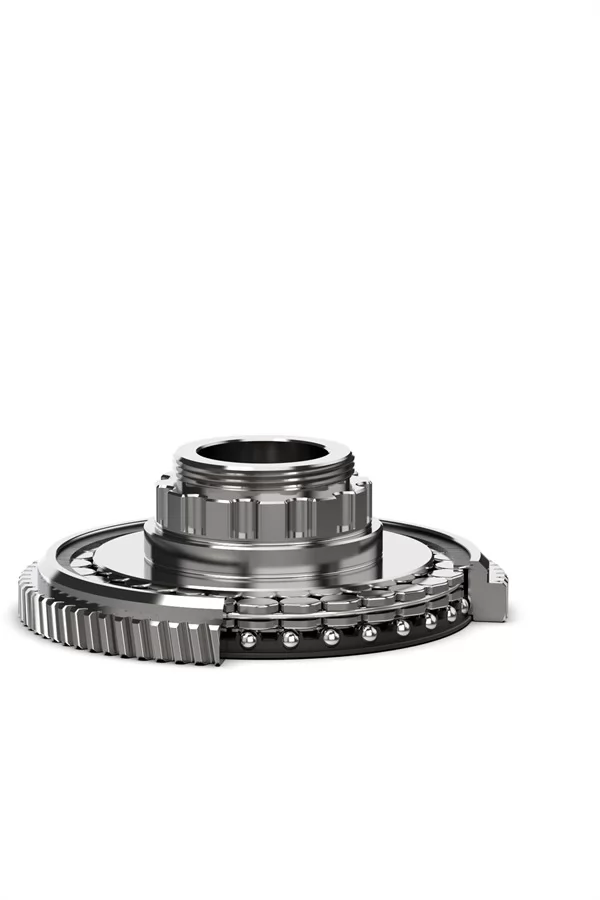
One-Way Bearing (Integrated Clutch Bearing)
Integrated Design High Concentricity 30%+ Load Increase
A one-way bearing (also called an overrunning clutch bearing or integrated clutch bearing) combines a one-way clutch mechanism with a deep groove ball bearing in a single integrated unit, machining the bearing raceway directly into the clutch housing to eliminate the separate bearing, improve concentricity, and increase load capacity by 30% or more compared to a conventional clutch-plus-bearing assembly. BOM engineers each custom one-way bearing variant from your torque, speed, and envelope constraints.
- Integration: bearing raceway machined into clutch housing with no separate bearing required
- Load Gain: ≥30% higher load vs. conventional clutch+bearing combination
- Concentricity: clutch housing and raceway share a single machined axis
- Clutch Options: roller / sprag / ratchet (contact us to confirm) supported types
- Applications: e-bikes, industrial one-way drives, backstop mechanisms, overrunning applications
The Challenge: Clutch + Bearing Assembly
One-way clutches (overrunning clutches) and deep groove ball bearings are frequently used together: the clutch provides one-directional torque transmission while the bearing provides radial support and precise rotation. In conventional designs, these are separate components assembled together, creating concentricity errors, adding unnecessary bulk, and imposing structural limits on load capacity. The question is whether these two functions can share a single structure instead of coexisting as separate parts.
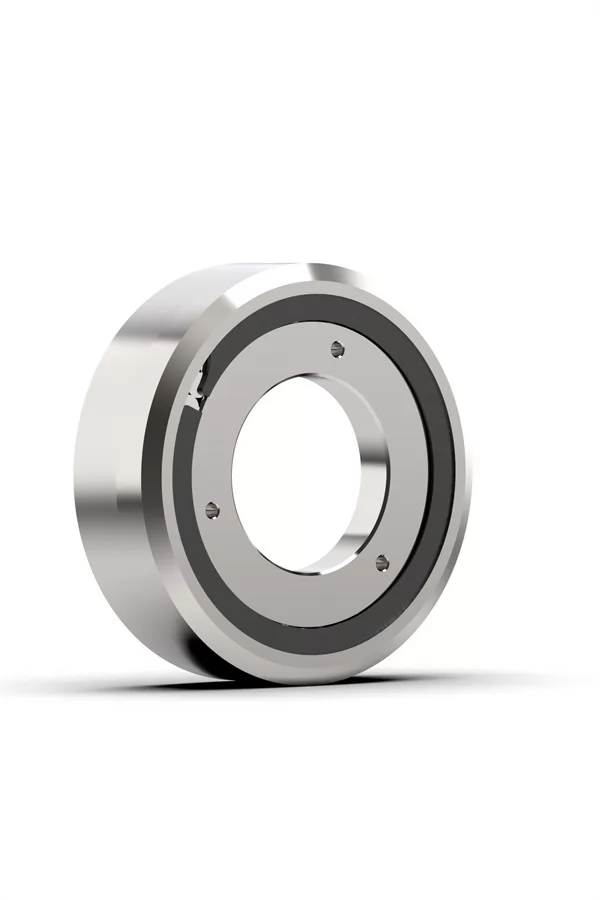
Poor Concentricity Destabilizes the Clutch
In a conventional arrangement, the deep groove ball bearing is pressed into or onto the clutch housing as a separate component. The press-fit tolerance between the bearing outer ring and the clutch housing creates an eccentricity error. This misalignment introduces cyclic radial loading on the clutch elements during each revolution, reducing engagement consistency and accelerating wear on both the clutch and the bearing.
By machining the bearing raceway directly into the clutch housing in a single setup, the rolling track and the clutch mechanism share a common axis. The bearing and clutch no longer have a press-fit interface between them; concentricity is guaranteed by machining precision rather than assembly skill, delivering smoother engagement, more consistent overrunning behavior, and longer service life.
Two Components Where One Will Do
A conventional one-way clutch assembly consists of at minimum two separate components: the clutch mechanism and the supporting deep groove ball bearing. Each requires its own housing interface, and their combined axial and radial footprint constrains the surrounding structure. In weight-sensitive or space-critical designs, this unnecessary bulk is a direct design liability.
The integrated clutch bearing occupies only the space of the clutch housing itself. The separate bearing and its associated housing features (press-fit bore, retaining shoulder, and axial location hardware) are all eliminated. The resulting unit is lighter, shorter in the axial direction, and simpler to install. In e-bike bottom brackets, rear hubs, and compact industrial drives, this size reduction directly improves the system design.


Load Capped by Standard Ring Dimensions
When a standard bearing is pressed into a clutch housing, the wall thickness of the bearing rings is constrained by catalog dimensions. The clutch housing wall must accommodate the bearing outer ring, leaving little room to increase rolling element diameter. The result is a load rating limited by the standard catalog bearing, even when the available housing material could support a significantly more capable rolling element arrangement.
Because the clutch housing itself serves as the bearing outer ring, we are free to design the rolling element path and element size to the application requirement rather than to a catalog standard. Larger rolling elements (made possible by the increased wall thickness available when the housing IS the ring) raise the dynamic load rating by ≥30% compared to a standard bearing pressed into or onto the clutch, directly supporting higher radial loads and longer service intervals.
Applications
E-Bike & Electric Bicycle Drives
Electric bicycle pedal-assist systems and rear-hub motors rely on one-way clutches to decouple the motor from the cranks or wheel during coasting, and the integrated clutch bearing reduces hub weight and radial footprint while improving concentricity between the clutch axis and the hub bearing, directly contributing to smoother pedaling feel and longer drivetrain life.
Industrial Backstop Mechanisms
Backstop clutches prevent conveyors, elevators, and inclined drives from reversing under gravity when the motor stops. The integrated design reduces the radial space required for the backstop assembly and improves concentricity, ensuring consistent engagement on every stop event and reducing wear from eccentric loading.
Overrunning Clutch Applications
In drives where the output can overrun the input, such as two-speed transmissions, starter motors, and free-wheel hubs. The integrated clutch bearing provides more reliable overrunning behavior by eliminating the eccentricity-induced cyclic loading that degrades conventional separate-component assemblies.
Compact Power Transmission
Wherever a one-way clutch and radial bearing must coexist in a tight space (printing machinery, packaging equipment, and indexing mechanisms), and the integrated unit eliminates the separate bearing mounting, reduces component count, and simplifies assembly while improving overall mechanical performance.
About BOM Bearing
BOM Bearing designs and manufactures custom-integrated bearing solutions for applications where standard bearings reach their limits. Certified to ISO 9001, IATF 16949, and ISO 14001.
- Certified Quality Management: ISO 9001, IATF 16949, and ISO 14001, meeting the rigorous quality standards required by demanding global OEM supply chains
- Engineering from Your Requirements: Share your current bearing setup and performance targets. Our engineering team works from your constraints, not from catalog limitations
- Technical Partnership: End-to-end engineering support, from analysis of your existing assembly through design, prototyping, and production
- Trusted by Industry Leaders: Custom integrated bearings adopted by global market leaders across industrial automation, robotics, and transportation & logistics
_1770101839_WNo_400d600.webp)
Frequently Asked Questions (FAQ)
What clutch mechanism types can be integrated?
We support roller-type and sprag-type overrunning clutch mechanisms (the two types that cover the vast majority of industrial and mobility applications. Roller clutches offer smooth, progressive engagement suited to high-cycle and speed-sensitive drives; sprag clutches handle higher torque density and asymmetric loading. Tell us your torque, overrunning speed, and engagement frequency, and we will design the right mechanism directly into the bearing housing.
Can the integrated clutch bearing replace my existing separate clutch and bearing combination?
In most cases, yes. Our engineering team will review your existing arrangement (clutch housing dimensions, bearing bore and outside diameter, axial length) and design an integrated unit that matches your mounting interfaces while delivering improved concentricity and load capacity. Contact us with your current component drawings for an evaluation.
What is the maximum overrunning speed for the integrated clutch bearing?
Maximum overrunning speed depends on the clutch mechanism type, rolling element size, and lubrication arrangement. Provide your operating speed requirements and we will design a configuration that meets your performance targets. Standard e-bike and light industrial applications are well within our design envelope.
How does the one-way clutch mechanism work under load, and what makes it effective for backstop and overrunning applications?
The integrated clutch bearing transmits full torque in the driving direction through wedging action (roller or sprag), while in the opposite direction the clutch elements disengage and allow the outer ring to spin freely while the bearing continues to carry radial load without interruption. This selective engagement is what makes the design invaluable in conveyor backstops (preventing reverse motion under gravity load), printing press freewheeling drives (decoupling rollers during speed changes), and indexing mechanisms (locking in one rotational direction per cycle). Because the clutch and bearing share a single raceway structure in our integrated design, the transition between engaged and free-running states is faster and more consistent than in separately assembled clutch-plus-bearing combinations.
What if my backstop or overrunning application has different torque or speed requirements than existing designs?
Every One-Way Bearing is engineered from your application constraints, not from a catalog. Share your overrunning speed, backstop torque, engagement response time, and space envelope, and our engineering team designs from there. Clutch mechanism type, sprag or roller geometry, ring cross-section, material selection, and surface treatment are all within the design scope.
0 Comments
Share your thoughts
Showing 6
of 0
reviews
Your rating
Your review *
Your Name *
Enter your Name
Your Email *
Enter your Email
Submit
Contact Us
Get in Touch with Us
Name can't be empty
Email error!
Message can't be empty
error
Send Your Message