

Special Bearings


Flange Integrated Bearing
BOM designs and manufactures the Flange Integrated Bearing, a custom-engineered unit where the mounting flange is machined as an integral feature of the bearing outer ring rather than press-fitted as a separate housing around a standard bearing. One-piece construction removes the tolerance stack between bearing and flange, eliminates press-fit eccentricity, shrinks the radial and axial envelope, and enables thicker ring walls with larger rolling elements for 30% or more higher load capacity. Adopted by global market leaders in industrial automation, robotics, and sewing and textile machinery.
Key Advantages
-
Integral Flange and Bearing Ring (One-Piece Construction)
-
Zero Press-Fit Eccentricity Between Mounting and Rolling Axes
-
Reduced Radial and Axial Envelope vs. Bearing-Plus-Flange-Housing
-
30% or More Higher Dynamic Load Rating Within the Same Bolt Circle
-
Lower Component Count and Assembly Labor in the Machine Builder's BOM
-
Engineering Collaboration Available: Custom Flange Profile, Bolt Pattern, and Ring Geometry Designed from Your Application Constraints
Product Inquiry
Product Category
Speak To One of Our Experts
Name can't be empty
Email error!
Message can't be empty
Send message
*We respect your confidentiality and all information are protected.
Description
Reviews
_1775529807_WNo_600d900.webp)
Flange Integrated Bearing
Integrated Design Zero Press-Fit Eccentricity 30%+ Load Increase
A flange integrated bearing is a custom-engineered unit where the mounting flange is machined as an integral part of the bearing outer ring, rather than press-fitted as a separate housing around a standard bearing. This one-piece construction eliminates the eccentricity introduced by flange press-fitting, reduces overall envelope size, and enables thicker ring walls with larger rolling elements for 30% or more higher load capacity. BOM engineers each variant from your application constraints, so the flange interface, bore geometry, and load profile all fit the target assembly without forcing a catalog compromise.
- Integration: mounting flange machined integral with bearing outer ring
- Concentricity: coaxial by construction, with no press-fit eccentricity
- Envelope: reduced radial and axial footprint vs. bearing plus separate flange housing
- Load Gain: ≥30% higher vs. conventional flanged assembly through thicker ring walls
- Engineering Scope: flange profile, bolt pattern, ring geometry, and seal interface all designed around your application
Why a Flange Integrated Bearing
In equipment where a rotating shaft must be supported AND located axially at a housing face, the conventional approach is to press a standard deep groove ball bearing into a separately machined flange housing. This layered assembly stacks press-fit tolerances between the bearing outer ring and the flange bore, consumes radial and axial space that the machine frame often cannot spare, and constrains rolling element size to whatever fits inside a thin-walled catalog bearing. Each of these constraints becomes a measurable cost in precision, envelope, and service life.
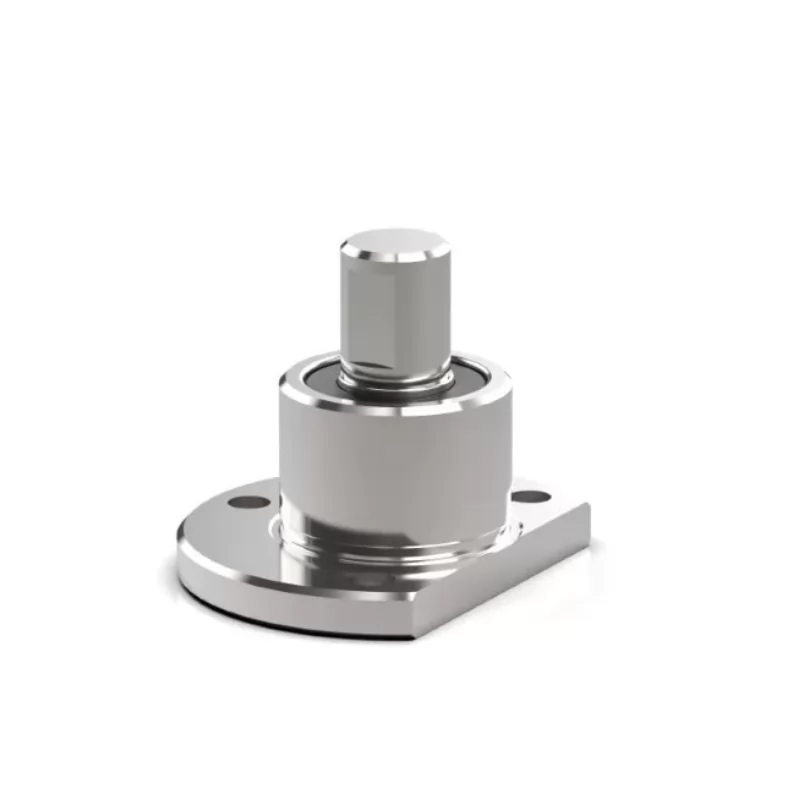
Press-Fit Eccentricity Corrupts Shaft Alignment
When a standard bearing is pressed into a separately machined flange housing, the interference between the housing bore and the bearing outer ring introduces an eccentricity error. This error is not a machining defect; it is a structural consequence of joining two parts whose tolerances add rather than cancel. The rolling-element axis ends up offset from the flange mounting axis by a few micrometers, and at elevated speeds this offset shows up as vibration, elevated noise, accelerated seal wear, and degraded runout at the driven component.
The flange integrated bearing machines the flange face and the bearing raceway from the same ring blank in a single clamping setup. The mounting axis and the rolling axis are identical by construction, so there is no tolerance stack between them. The eccentricity that limits a press-fitted assembly is eliminated at the source, delivering cleaner rotation, lower vibration, and longer seal and raceway life in precision-motion applications.
For equipment builders, this also simplifies inspection and assembly: runout between the flange face and the raceway is verified once at the bearing factory, rather than re-measured at every machine build after the press-fit step.
A Separate Flange Housing Wastes Radial and Axial Space
A conventional bearing-plus-flange-housing assembly occupies noticeably more space than the load path strictly requires. The housing wall adds radial dimension, the press-fit shoulder adds axial length, and the bolt flange extends outward past the bearing outer diameter. In compact machine designs, robotic joints, and shaft-end supports where packaging is already tight, every millimeter consumed by housing overhead is a millimeter the designer cannot use for shaft, gearing, or sensor integration.
The flange integrated bearing eliminates the separate housing entirely. The flange IS the bearing outer ring, extended outward with a bolt pattern machined directly into the ring face. Radially, the unit sits within roughly the same envelope as the rolling elements and the bolt circle; axially, the unit occupies only the width of the raceway plus the flange thickness. The weight drops correspondingly, which matters whenever the bearing is mounted on a moving element such as a robotic link or a servo-driven arm.
The space reclaimed is often enough to shorten machine frames, allow a larger shaft diameter inside the same envelope, or fit an additional sensor or seal feature that a conventional assembly would have pushed out of reach.
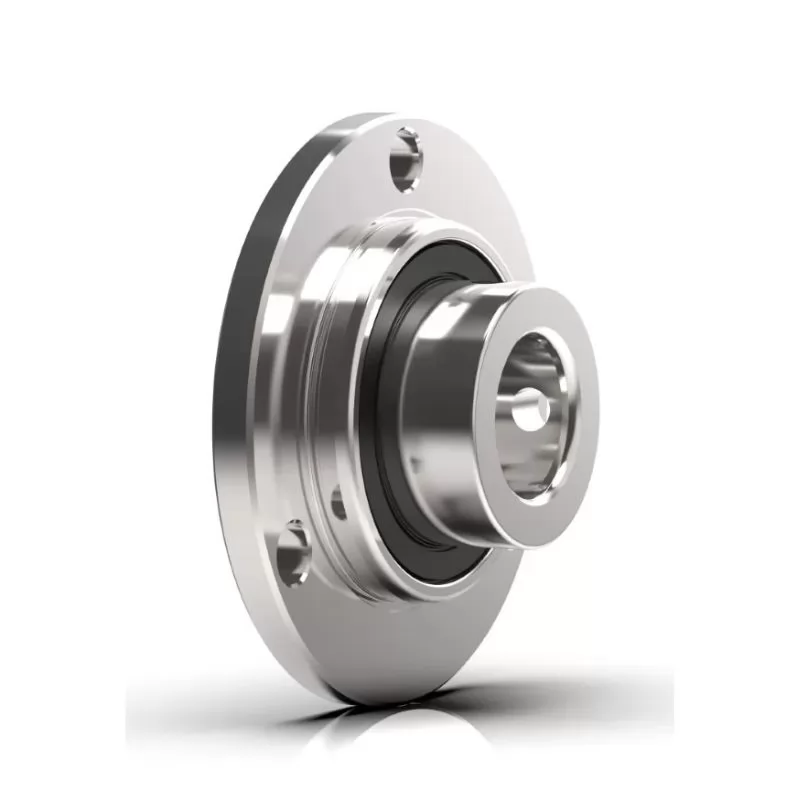
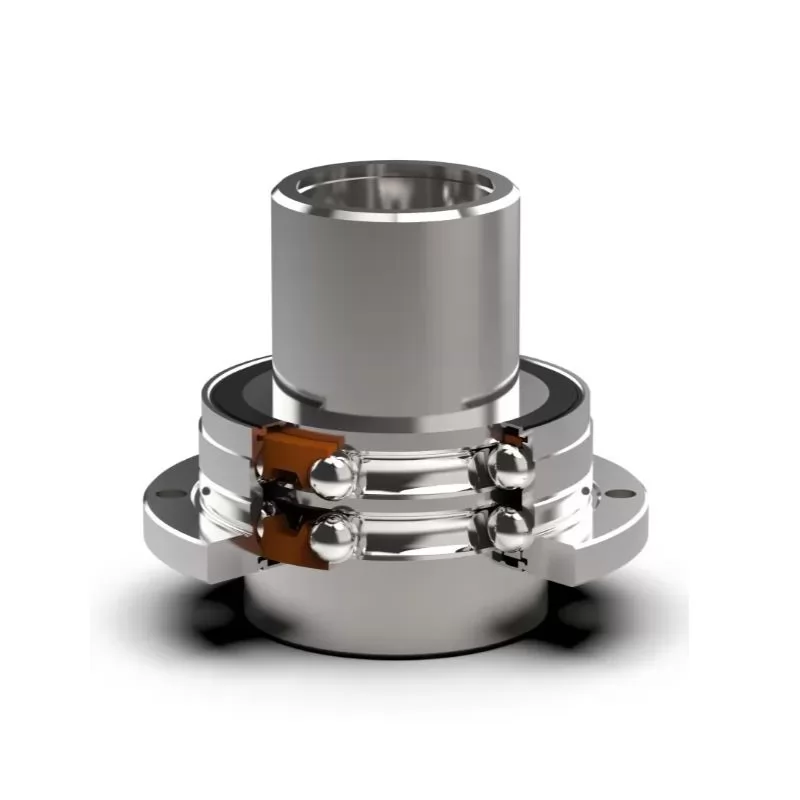
Load Capped by Standard Bearing Wall Thickness
When a standard bearing is chosen to fit a flange housing bore, the wall thickness of the bearing outer ring is fixed by catalog dimensions. Press-fitting further reduces the effective ring stiffness, because the interference load preloads the raceway before the external working load ever arrives. The combined result is a limited rolling element size, a reduced dynamic load rating, and a lower fatigue life ceiling than the surrounding housing material could actually support.
With the flange and ring manufactured as one piece, the wall thickness of the ring section is no longer constrained by catalog geometry. The ring cross section can be sized to the application, and the rolling element diameter can be enlarged accordingly. The resulting dynamic load rating is typically 30% or more above a standard bearing pressed into a flange housing of the same outside diameter and bolt circle, directly translating into higher transmitted torques or longer service intervals for equivalent loads.
Because the raceway and the flange face share a machining setup, surface finish, hardness, and raceway geometry can all be tuned to the load spectrum without worrying about post-assembly distortion.
Applications
Shaft-End Support and Axial Positioning
At the end of a rotating shaft, a bearing must provide both rotation support and a rigid axial reference against a housing face. The flange integrated bearing performs both functions in one unit, with the flange face carrying axial load into the housing while the raceway handles rotation, eliminating the misalignment between two separate features that a bolt-on flange housing introduces.
Robotic Joint Rotational Support
Robotic joints require compact size, low weight, high concentricity, and growing load capacity as payloads increase. Integrating the flange with the bearing ring cuts component count, shortens the joint, and delivers the concentricity that direct-drive and harmonic-reducer joints depend on for repeatable positioning accuracy.
Sewing and Textile Machinery
High-speed sewing heads, winding machines, and textile drive shafts operate at sustained RPM with tightly controlled vibration budgets. A flange integrated bearing reduces assembly variation from batch to batch, keeping noise, temperature, and runout within specification without relying on hand-fitted press-fit work at the machine builder.
Compact Automation Drives
Servo-driven linear actuators, conveyor modules, and indexing tables often ask a single bearing to carry shaft load and provide the mounting interface to the frame. Integrating the flange with the ring removes one machined housing from the bill of materials, simplifies inventory, and lowers the overall weight of the moving assembly.
Flange Integrated Bearing - Reference Configurations
Production reference models shown below | Custom variants engineered from your application constraints | Contact us for specifications not listed
| Designation | Structure |
Flange OD (D2) mm |
Bearing OD (D1) mm |
Width (B2) mm |
Flange Width (B1) mm |
Bore (d) mm |
Inner Ring Len (d3) mm |
Flange Holes | Inner Thread |
|---|
About BOM Bearing
BOM Bearing designs and manufactures custom-integrated bearing solutions for applications where standard bearings reach their limits. Certified to ISO 9001, IATF 16949, and ISO 14001.
- Certified Quality Management: ISO 9001, IATF 16949, and ISO 14001, meeting the rigorous quality standards required by demanding global OEM supply chains
- Engineering from Your Requirements: Share your current bearing setup and performance targets. Our engineering team works from your constraints, not from catalog limitations
- Technical Partnership: End-to-end engineering support, from analysis of your existing assembly through design, prototyping, and production
- Trusted by Industry Leaders: Custom integrated bearings adopted by global market leaders across industrial automation, robotics, and transportation & logistics
_1770101839_WNo_400d600.webp)
Frequently Asked Questions (FAQ)
How much performance gain does a flange integrated bearing actually deliver?
The improvement shows up in three measurable ways. Concentricity between the flange face and the rolling axis drops from the tens of micrometers typical of a press-fit assembly down to single-digit micrometers set by a single machining setup. Dynamic load rating typically rises by 30% or more within the same bolt-circle envelope, because the ring wall and rolling element size are no longer constrained by a catalog bearing fitted into a housing. Radial and axial envelope both shrink, which is often what allows the design to move forward at all in space-critical machines.
Can a flange integrated bearing replace my current bearing-plus-flange-housing assembly?
In most cases, yes. We typically preserve the shaft diameter, bolt circle, bolt count, and mounting face location so the integrated unit drops into the existing mating parts without machine redesign. Send us the current drawing or sample and we confirm which interfaces stay the same and which can be refined to unlock further envelope or load gains.
Why does press-fitting a flange housing onto a standard bearing cause concentricity errors?
A press fit is an interference joint between two separately machined parts. Each part has its own tolerance zone for bore diameter, ovality, and roundness. When they are forced together, the outer ring slightly deforms to match the housing bore, and the resulting rolling surface geometry differs from the original free-state raceway. The mounting axis (the flange face) and the rolling axis (the raceway) are now two different axes with a small but measurable offset. Machining both from one ring blank in one setup eliminates this entirely.
Which industries are using integrated flange bearings today?
Current adoption is concentrated in industrial automation (servo drives, indexing tables, conveyor modules), robotics (joint rotation and direct-drive axes), textile and sewing machinery (drive shafts and winding heads), and compact automation equipment where space and weight budgets rule out a separate flange housing. Adoption continues to expand into packaging machinery and shaft-end support applications in precision machine tools.
What if my application does not match any existing flange integrated bearing configuration?
Every flange integrated bearing BOM produces starts from a specific application, so there is no fixed catalog to match against. Share your operating conditions: shaft diameter, flange interface (bolt pattern or register feature), load spectrum, speed, and envelope constraints. Our engineering team analyses your current assembly, proposes an integrated design, iterates the geometry with you, and moves into prototyping and production once the design fits your machine. The product is always engineered from the constraints you provide, not adapted from a catalog.
0 Comments
Share your thoughts
Showing 6
of 0
reviews
Your rating
Your review *
Your Name *
Enter your Name
Your Email *
Enter your Email
Submit
Contact Us
Get in Touch with Us
Name can't be empty
Email error!
Message can't be empty
error
Send Your Message