

Crossed Roller Bearings


Crossed Roller Bearing
BOM manufactures cross roller bearings across four interchangeable series — CRBH inseparable high-rigidity type, RB separable outer ring type, RU integrated bolt-in type, and SX ultra-thin split-inner type. Cylindrical rollers arranged in an alternating 90° cross pattern carry combined radial, bidirectional axial, and overturning moment loads in a single compact bearing. Bore range covers 20 mm to 1250 mm depending on series. Full-specification custom manufacturing including integrated bearing assemblies is available.
Key Features
-
Four Series — CRBH, RB, RU, SX
-
Combined Radial, Axial, and Moment Load Capability
-
Separator-Guided Rollers for Smooth Rotation
-
P6 / P5 / P4 / P2 Precision Grades
-
Bore Range 20–1250 mm Across All Series
-
Full-Specification Custom Manufacturing Available
Product Inquiry
Product Category
Speak To One of Our Experts
Name can't be empty
Email error!
Message can't be empty
Send message
*We respect your confidentiality and all information are protected.
Description
Reviews
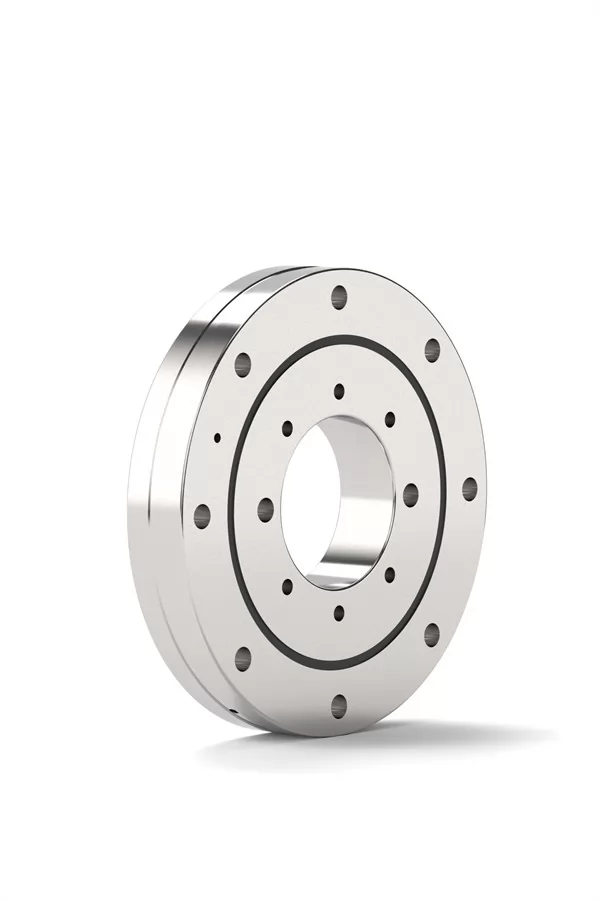
Cross Roller Bearings
High Rigidity Radial · Axial · Moment
BOM manufactures cross roller bearings across four interchangeable series: CRBH inseparable high-rigidity type, RB separable outer ring type, RU integrated bolt-in type, and SX ultra-thin split-inner type. Cylindrical rollers are arranged in an alternating 90° cross pattern with separator spacers, enabling a single bearing to carry combined radial, bidirectional axial, and overturning moment loads. Bore range covers 20 mm to 1250 mm depending on series.
- Combined Load Capability: Simultaneous radial, bidirectional axial, and overturning moment loads in a single-row, compact-section bearing, replacing paired angular contact ball bearing arrangements
- Four Series Coverage: CRBH (inseparable, high-rigidity), RB (separable outer ring), RU (integrated mounting holes), SX (ultra-thin, split inner ring), matching each application's structural and envelope requirements
- Separator-Guided Rollers: Individual separator spacers between each roller ensure smooth, low-friction rotation with minimal heat generation and consistent torque behavior
- Precision Grades: P6 / P5 / P4 / P2 precision grades available; open and sealed configurations for rotary table, robot joint, and semiconductor equipment applications
- Mounting Flexibility: RU series with through-bolt holes for direct flange mounting; CRBH and RB for conventional shaft-and-housing installation; SX for ultra-thin envelope constraints
- Customization: Full-specification custom manufacturing available, covering dimensions, materials, coatings, and bearing structure
Cross Roller Bearings: Dimensions & Load Ratings
CRBH, RB, RU, and SX series shown | Contact us for sizes not shown
| Designation | d (mm) | D (mm) | B (mm) | Cr (kN) | C0r (kN) | Weight (kg) |
|---|
Custom Cross Roller Bearing Manufacturing
Integrated Assemblies Engineering Support
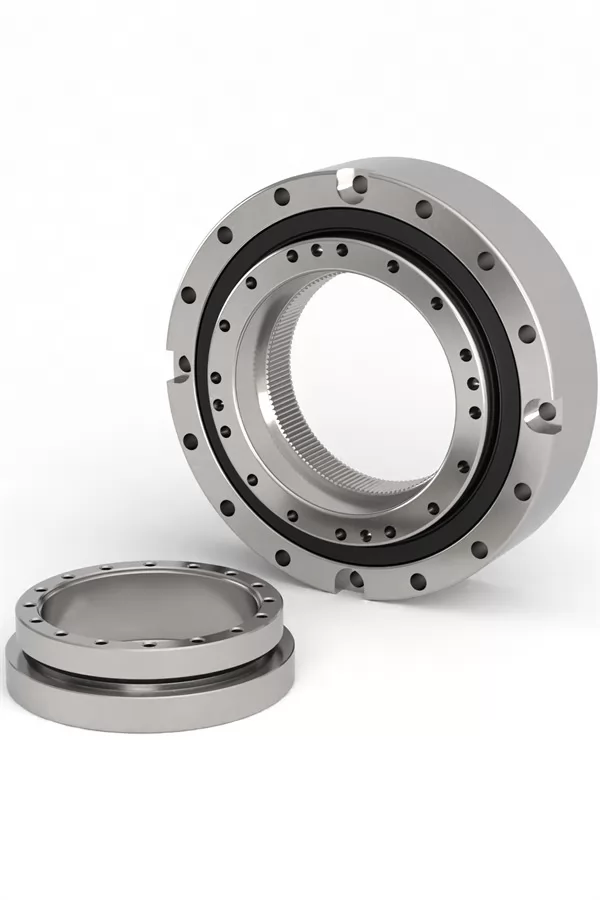
Beyond standard catalog sizes, BOM manufactures cross roller bearings integrated with output flanges, hollow shafts, or rotary table plates as a single precision-machined unit, eliminating assembly stack-up errors and producing a more compact, higher-performing rotary module tailored to the exact application envelope.
- Integrated Assemblies: Cross roller bearing integrated with output flange, hollow shaft, or rotary plate as one unit, delivering more compact structure, smaller envelope, higher moment load capacity than separately assembled components
- Precision Advantage: One-piece machining eliminates assembly stack-up errors between bearing rings and mating flanges, delivering combined accuracy that cannot be matched by bolting separate parts together
- Dimension Customization: Non-standard bore, OD, and section width; special cross-section proportions for proprietary shaft and housing designs
- Preload & Clearance Options: Light preload, zero preload, or custom clearance settings; sealed and open designs
- Customization: Full-specification custom manufacturing available, covering dimensions, materials, coatings, and bearing structure
Applications
Industrial Robots & Articulated Arms
CRBH and RB cross roller bearings support combined radial, axial, and moment loads at every joint of 6-axis robots and SCARA arms. The compact single-row cross-section replaces paired bearing arrangements, reducing joint length and increasing positioning accuracy under load.
CNC Rotary Tables & 4th / 5th Axis
High static stiffness resists cutting-force deflection during 4th and 5th axis interpolated machining. RU series with bolt-in mounting holes simplifies table construction; CRBH inseparable rings maintain sub-micron indexing accuracy under heavy cutting loads.
Semiconductor & FPD Equipment
Wafer transfer robots, inspection stages, and photolithography systems rely on cross roller bearings for sub-micron positioning repeatability. SX ultra-thin series fits inside compact cleanroom handlers where envelope space is critically limited.
Medical Imaging & Surgical Robotics
CT gantries, C-arm rotation systems, and minimally invasive surgical robots use cross roller bearings for smooth, precise rotation under high overturning moments, combining the rigidity of a large-bore bearing with the compact cross-section critical in medical equipment design.
About BOM Bearing
BOM Bearing is a professional manufacturer of cross roller bearings, delivering high-rigidity rotary solutions for industrial robots, precision machinery, semiconductor equipment, and medical systems worldwide.
- Quality Assurance: ISO 9001, IATF 16949, and ISO 14001 certified; quality and environmental standards validated at every production stage
- Product Range: CRBH inseparable type, RB separable outer ring type, RU bolt-in type, and SX ultra-thin type; bore 20 to 1250 mm across all series with larger sizes on request
- Custom Manufacturing: Full-specification customization from non-standard dimensions and alternative materials to specialized coatings and complete bearing architecture redesign, engineered to your exact requirement
- Technical Support: Engineering team for series selection, precision grade matching, and integrated assembly design
- Fast Delivery: Efficient production lines and global logistics network ensuring timely delivery worldwide
_1770101839_WNo_400d600.webp)
Frequently Asked Questions (FAQ)
What is the difference between the four cross roller bearing series BOM manufactures?
CRBH has inseparable (one-piece) inner and outer rings for highest rigidity and supports both inner and outer ring rotation. RB has a separable (split) outer ring with an integral inner ring, optimized for inner ring rotation applications and easier roller installation. RU has integrated inner and outer rings with pre-machined bolt holes on both rings for direct flange mounting without separate housings. SX is an ultra-thin type with a split inner ring and integral outer ring. It has the thinnest cross-section in the range, suited for applications with severe space constraints. All four types use the same 90° alternating roller arrangement and carry combined radial, axial, and moment loads.
How do cross roller bearings compare to angular contact ball bearings for robot joints?
Angular contact ball bearings use point contact and must be paired in back-to-back (DB) or face-to-face (DF) arrangements to handle bidirectional axial and moment loads, doubling the axial envelope and requiring careful preload management. A single cross roller bearing uses line contact with rollers alternating at 90°, carrying radial, axial, and moment loads simultaneously in one row with a thinner cross-section. This gives cross roller bearings roughly 3 to 4 times the moment stiffness at the same bore diameter. The tradeoff is speed: angular contact ball bearings achieve higher limiting speeds. In practice, most robot joints operate below 300 rpm, well within cross roller bearing limits, so the stiffness and compactness advantages outweigh the speed difference.
What precision grades are available and how do I select the right one?
BOM manufactures cross roller bearings in P6, P5, P4, and P2 precision grades. P6 is suitable for general industrial rotary tables and indexing mechanisms. P5 is the most common grade for industrial robot joints, where it balances cost and positioning accuracy. P4 is used in semiconductor wafer-handling robots, optical inspection stages, and other applications requiring sub-micron positioning repeatability. P2 is the highest grade, reserved for metrology instruments and ultra-precision positioning systems. Higher precision grades have tighter tolerances on radial and axial runout, dimensional accuracy, and rotational accuracy. Contact BOM's engineering team for grade-specific tolerance tables.
What is an integrated cross roller bearing assembly?
An integrated assembly combines the cross roller bearing with mating components (output flange, hollow shaft, or rotary plate) into a single precision-machined unit. This eliminates the clearances and dimensional stack-up errors introduced by bolting separate parts together, producing a more compact rotary module with higher combined accuracy and higher moment load capacity. Integrated assemblies are particularly valuable in robot joint actuators where every micron of positional error matters.
Can BOM manufacture custom cross roller bearings?
Yes. BOM manufactures cross roller bearings with non-standard bore, OD, and section width, as well as custom preload settings, sealed versions, alternative materials, specialized coatings, and integrated assemblies combining the bearing with application-specific flanges and housings. BOM's capability extends to complete bearing architecture redesign for applications where no catalog product meets the requirement. Contact our engineering team with your load requirements, speed, and application specifics.
0 Comments
Share your thoughts
Showing 6
of 0
reviews
Your rating
Your review *
Your Name *
Enter your Name
Your Email *
Enter your Email
Submit
Contact Us
Get in Touch with Us
Name can't be empty
Email error!
Message can't be empty
error
Send Your Message