

Linear guide rail


Telescopic Rail
BOM manufactures heavy-duty partial extension telescopic rails for applications requiring high rigidity and low deflection under load. Raceways are precision-ground after heat treatment to achieve tight surface finish and dimensional accuracy, delivering smoother motion, lower running resistance, and better positioning repeatability than conventional cold-drawn profiles. Extension ratios from 50% to 70% are available across different models.
Key Features
-
BMT28 Core Series, Larger Sizes Available
-
Partial Extension
-
Precision-Ground Raceways
-
Zinc, White Zinc, and Nickel Plating Available
-
Positioning Repeatability for Automated Equipment
-
Custom Rail Lengths and Surface Treatments Available
Product Inquiry
Product Category
Speak To One of Our Experts
Name can't be empty
Email error!
Message can't be empty
Send message
*We respect your confidentiality and all information are protected.
Description
Reviews
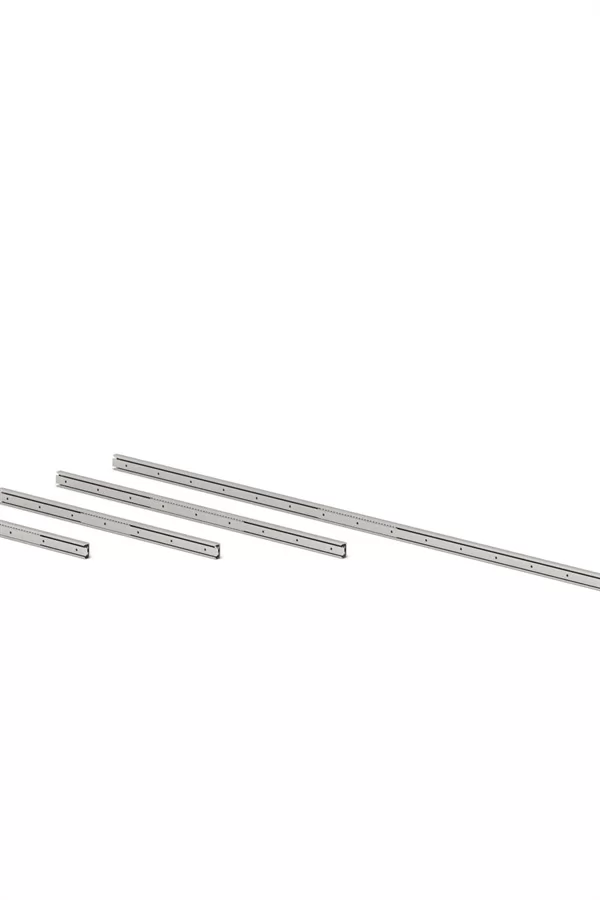
Telescopic Rails
Partial Extension Precision Ground Raceways
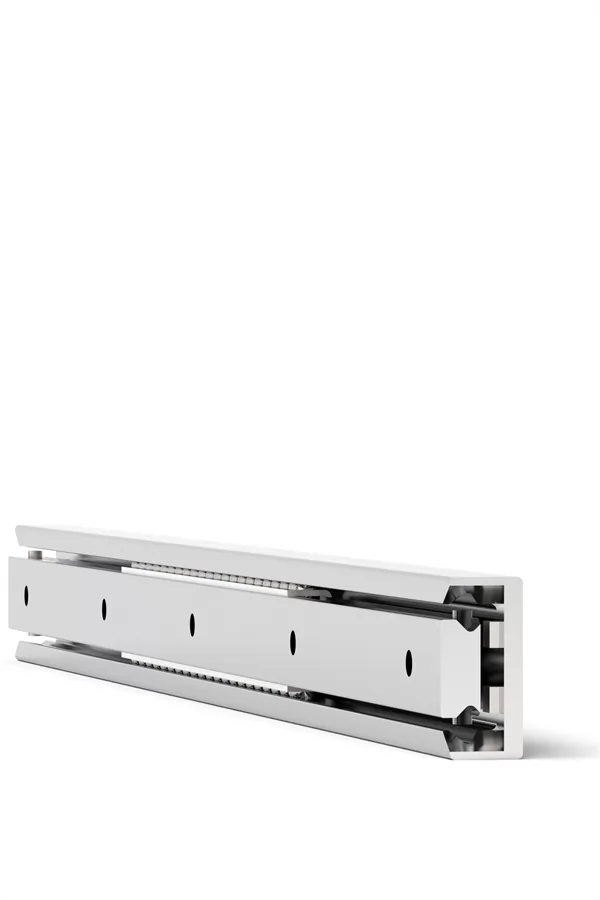
BOM manufactures heavy-duty partial extension telescopic rails for applications requiring high rigidity and low deflection under load. Raceways are precision-ground after heat treatment to achieve tight surface finish and dimensional accuracy, delivering smoother motion, lower running resistance, and better positioning repeatability than conventional cold-drawn profiles. Extension ratios from 50% to 70% are available across different models to match a wide range of stroke and installation requirements.
- Load Capacity: Section size 28 as the core product line; section sizes 35 and 43 available for higher load requirements. Optimized profile cross-sections support vertical loads, lateral loads, and moment loads simultaneously
- Precision Ground Raceways: Raceways are ground to final geometry after heat treatment, producing uniform surface finish and consistent ball-to-raceway contact for smooth, low-friction motion across the full stroke
- Surface Protection: Zinc plating, black zinc plating, white zinc plating, and nickel plating available. Surface treatment selected to match the operating environment and corrosion resistance requirements
- Positioning Repeatability: Tight raceway straightness from precision grinding translates directly to consistent stroke length, critical for servo-driven automated equipment
- Extension Ratio: 50% to 70% partial extension across different models, matching a wide range of stroke and installation requirements while maintaining high rigidity in the extended position
- Customization: Full-specification custom manufacturing available, covering dimensions, materials, coatings, and bearing structure
Telescopic Rails: Dimensions & Load Ratings
BMT28 series (section size 28) shown | Load ratings per pair | BMT35 and BMT43 series available; contact BOM for specifications
| Designation | Cross Ref. |
L mm |
Stroke S mm |
Cy N |
Cz N |
Mx Nm |
My Nm |
Mz Nm |
C100 N |
Holes |
|---|---|---|---|---|---|---|---|---|---|---|
| BMT28-130 | ASN28-0130 | 130 | 74 | 612 | 430 | 16 | 21 | 29 | 873 | 2 |
| BMT28-210 | ASN28-0210 | 210 | 116 | 1117 | 782 | 27 | 59 | 83 | 1579 | 3 |
| BMT28-290 | ASN28-0290 | 290 | 148 | 1935 | 1355 | 40 | 133 | 187 | 2693 | 4 |
| BMT28-370 | ASN28-0370 | 370 | 190 | 2446 | 1712 | 51 | 214 | 306 | 3403 | 5 |
| BMT28-450 | ASN28-0450 | 450 | 232 | 2956 | 2070 | 62 | 315 | 450 | 4120 | 6 |
| BMT28-530 | ASN28-0530 | 530 | 274 | 3467 | 2427 | 73 | 436 | 620 | 4835 | 7 |
| BMT28-610 | ASN28-0610 | 610 | 316 | 3978 | 2785 | 83 | 577 | 820 | 5558 | 8 |
| BMT28-690 | ASN28-0690 | 690 | 358 | 4489 | 3142 | 94 | 736 | 1051 | 6273 | 9 |
| BMT28-770 | ASN28-0770 | 770 | 400 | 4996 | 3499 | 105 | 915 | 1308 | 6985 | 10 |
| BMT28-850 | ASN28-0850 | 850 | 433 | 5829 | 4082 | 118 | 1166 | 1667 | 8113 | 11 |
| BMT28-930 | ASN28-0930 | 930 | 475 | 6336 | 4437 | 130 | 1390 | 1985 | 8810 | 12 |
| BMT28-1010 | ASN28-1010 | 1010 | 517 | 6849 | 4795 | 140 | 1633 | 2329 | 9526 | 13 |
| BMT28-1090 | ASN28-1090 | 1090 | 559 | 7359 | 5150 | 151 | 1894 | 2704 | 10239 | 14 |
| BMT28-1170 | ASN28-1170 | 1170 | 601 | 7868 | 5508 | 162 | 2176 | 3109 | 10953 | 15 |
Custom Telescopic Rail Manufacturing
Customizable Engineering Support
BOM manufactures custom telescopic rails for applications where standard catalog specifications do not meet the installation envelope, load case, or environmental requirements. Custom capabilities span non-standard rail lengths and mounting interfaces to application-specific surface treatments and locking configurations.
- Rail Length: Non-standard closed lengths manufactured to your installation envelope, including any length outside the standard catalog range
- Mounting Interface: Side-mount, bottom-mount, or top-mount configurations with custom hole patterns and bracket geometry matched to your equipment structure
- Locking & End Stops: Optional positive locking at retracted and/or extended position; damper and end-stop force specifications tailored to load and cycle requirements
- Surface Treatment: Zinc plating, black zinc plating, white zinc plating, and nickel plating. Additional anti-corrosion coatings available for harsh operating environments
- Customization: Full-specification custom manufacturing available, covering dimensions, materials, coatings, and bearing structure
Applications
Automated Warehouse & Logistics
AS/RS shuttle vehicles, AMR fork arms, and pallet retrieval systems use telescopic rails to extend into rack channels for goods transfer. Precision-ground raceways provide smooth, repeatable motion and low deflection required for uninterrupted 24/7 warehouse operation.
Special Vehicles & Emergency Equipment
Fire engines, utility trucks, and mobile workshop vehicles mount telescopic rails for equipment tray access, extending tool compartments, rescue gear drawers, and service modules under heavy load. Corrosion-protected surfaces withstand outdoor and harsh-weather exposure.
Rail & Public Transport
Passenger seat sliding mechanisms, barrier-free wheelchair ramp systems, and onboard equipment compartments in trains, buses, and aircraft rely on telescopic rails for smooth, controlled extension under dynamic loads and vibration during vehicle operation.
Heavy-Duty Packaging & Industrial Machinery
Press feeding mechanisms, packaging machine access panels, CNC machine tool trays, and heavy-load drawer systems in industrial equipment use telescopic rails where high vertical and lateral load capacity with low deflection is required during the extended stroke.
About BOM Bearing
BOM Bearing is a professional manufacturer of telescopic rails with precision-ground raceways, delivering heavy-duty linear extension solutions for automated logistics, special vehicles, rail transport, and industrial machinery worldwide.
- Quality Assurance: ISO 9001, IATF 16949, and ISO 14001 certified; quality and environmental standards validated at every production stage
- Wide Product Range: BMT28 series covering rail lengths from 130 to 1170 mm with precision-ground raceways; section sizes 35 and 43 available for higher load applications
- Custom Manufacturing: Full-specification customization from non-standard dimensions and alternative materials to specialized coatings and complete bearing architecture redesign, engineered to your exact requirement
- Technical Support: Professional engineering team for load analysis, stroke specification, mounting interface review, and application guidance
- Fast Delivery: Efficient production lines and global logistics network ensuring timely delivery
_1770101839_WNo_400d600.webp)
Frequently Asked Questions (FAQ)
How do precision-ground raceways improve telescopic rail performance?
Precision grinding shapes the raceway to its final geometry after heat treatment, producing a uniform surface finish and tightly controlled dimensional accuracy along the full rail length. This results in consistent ball-to-raceway contact, lower rolling resistance, smoother motion, and better positioning repeatability compared to conventional cold-drawn profiles where the raceway geometry is formed before heat treatment and may distort during hardening.
What factors determine telescopic rail load capacity?
Load capacity depends on three main factors: section size (profile cross-section height), rail length (longer rails support higher total load due to more ball circuits in contact), and extension ratio (the percentage of stroke relative to closed length). The BMT28 series covers a wide range of load requirements; larger section sizes are available for heavier applications. Vertical load (Cy), lateral load (Cz), and moment loads (Mx, My, Mz) are all specified in the catalog. Select the model that satisfies all load directions simultaneously.
What surface protection options are available for telescopic rails?
BMT series telescopic rails are available with zinc plating, black zinc plating, white zinc plating, and nickel plating, selected based on the operating environment and corrosion resistance requirements. Additional anti-corrosion coatings can be applied for harsh environments such as outdoor vehicles, marine equipment, or washdown areas. Contact BOM engineering to specify the optimal surface treatment for your application.
What is the difference between partial extension and full extension telescopic rails?
Partial extension rails (typically 50% to 70% stroke relative to closed length) use a two-member design with a single ball cage, resulting in higher load capacity and greater rigidity per unit length compared to full extension types. Full extension rails use three or more members to achieve 100% stroke but introduce additional ball cage stages, which reduce overall stiffness. BOM's BMT series is a partial extension design optimized for applications where load capacity and low deflection take priority over maximum stroke.
Can BOM manufacture custom telescopic rails?
Yes. BOM manufactures telescopic rails in custom rail lengths, mounting configurations, surface treatments, and structural configurations outside standard catalog specifications. Custom locking positions, end-stop configurations, and bracket geometry are also available. Contact our engineering team with your application requirements, including dimensions, materials, coatings, and any special structural needs, for a detailed proposal.
0 Comments
Share your thoughts
Showing 6
of 0
reviews
Your rating
Your review *
Your Name *
Enter your Name
Your Email *
Enter your Email
Submit
Contact Us
Get in Touch with Us
Name can't be empty
Email error!
Message can't be empty
error
Send Your Message