

Slewing Bearings


Slewing Bearing
BOM manufactures compact slewing bearings (slewing rings) in four-point contact ball and crossed roller configurations. A slewing bearing integrates axial, radial, and overturning moment loads in a single unit, replacing conventional multi-bearing arrangements. Available with external gear, internal gear, or ungeared configurations, with full-specification custom manufacturing for application-specific requirements.
Key Features
-
Four-Point Contact Ball & Crossed Roller Configurations
-
Combined Axial, Radial & Moment Load Capacity
-
External Gear, Internal Gear & Ungeared Options
-
Sealed & Pre-Lubricated with Relubrication Channels
-
Robotics, Medical, Packaging & Precision Automation
-
Full-Specification Custom Manufacturing Available
Product Inquiry
Product Category
Speak To One of Our Experts
Name can't be empty
Email error!
Message can't be empty
Send message
*We respect your confidentiality and all information are protected.
Description
Reviews
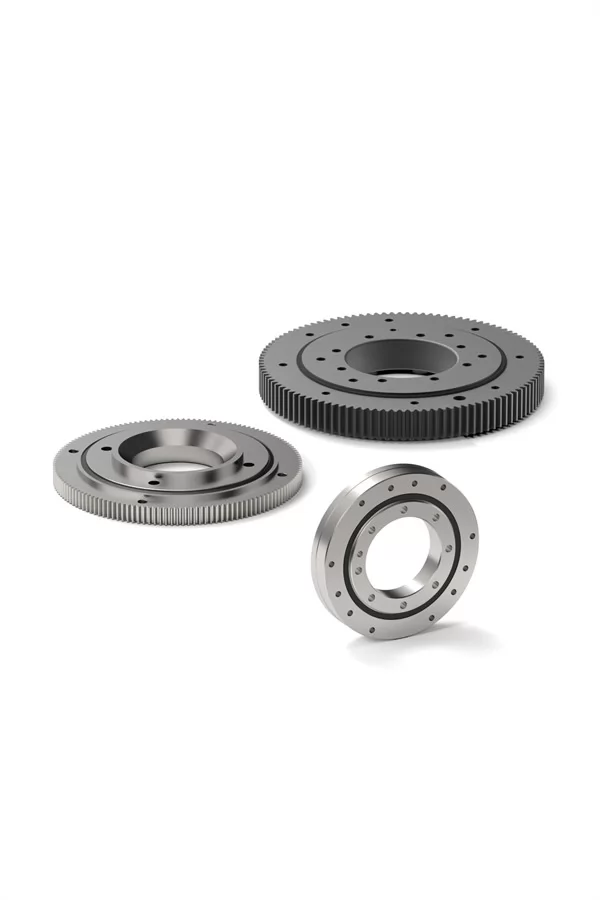
Slewing Bearings
Combined Load Customizable
BOM manufactures compact slewing bearings (slewing rings) in four-point contact ball and crossed roller configurations. A slewing bearing integrates axial, radial, and overturning moment loads in a single compact unit, replacing conventional multi-bearing arrangements. Available with external gear, internal gear, or ungeared configurations for robotics, medical equipment, packaging machinery, and precision automation applications.
- Load Integration: Simultaneous axial, radial, and overturning moment capacity in one bearing unit, replacing separate thrust and radial bearing arrangements and simplifying machine structure
- Four-Point Contact Ball: Each ball contacts the raceway at four points, providing balanced axial, radial, and moment capacity in a compact cross-section, the most versatile configuration for general automation and rotary positioning
- Crossed Roller: Cylindrical rollers arranged at alternating 90-degree angles provide line contact for significantly higher stiffness and moment resistance than ball types, preferred for precision positioning and high-rigidity applications
- Gear Options: External gear, internal gear, or ungeared; gear parameters specified to match the drive system
- Sealing & Lubrication: Elastomer seals on both faces retain lubricant and exclude contamination; grease fittings for periodic relubrication via internal distribution channels
- Customization: Full-specification custom manufacturing available, dimensions, materials, coatings, and bearing structure
Slewing Bearings — Dimensions & Ratings
Four-point contact ball type shown | Contact us for crossed roller, geared configurations, and sizes not listed
| Ungeared | External Gear | Internal Gear |
d mm |
D mm |
H mm |
D1 mm |
D2 mm |
dn mm |
dm |
L mm |
n/n1 |
|---|---|---|---|---|---|---|---|---|---|---|---|
| 010.20.200 | 011.20.200 | — | 120 | 280 | 60 | 248 | 152 | 16 | M14 | 28 | 12/2 |
| 010.20.224 | 011.20.224 | — | 144 | 304 | 60 | 272 | 176 | 16 | M14 | 28 | 12/2 |
| 010.20.250 | 011.20.250 | — | 170 | 330 | 60 | 298 | 202 | 16 | M14 | 28 | 18/2 |
| 010.20.280 | 011.20.280 | — | 200 | 360 | 60 | 328 | 232 | 16 | M14 | 28 | 18/2 |
| 010.25.315 | 011.25.315 | 013.25.315 | 222 | 408 | 70 | 372 | 258 | 18 | M16 | 32 | 20/2 |
| 010.25.355 | 011.25.355 | 013.25.355 | 262 | 448 | 70 | 412 | 298 | 18 | M16 | 32 | 20/2 |
| 010.25.400 | 011.25.400 | 013.25.400 | 307 | 493 | 70 | 457 | 343 | 18 | M16 | 32 | 24/2 |
| 010.25.450 | 011.25.450 | 013.25.450 | 357 | 543 | 70 | 507 | 393 | 18 | M16 | 32 | 24/2 |
| 010.25.500 | 011.25.500 | 013.25.500 | 398 | 602 | 80 | 566 | 434 | 18 | M16 | 32 | 20/4 |
| 010.30.500 | 012.30.500 | 014.30.500 | 398 | 602 | 80 | 566 | 434 | 18 | M16 | 32 | 20/4 |
| 010.25.560 | 011.25.560 | 013.25.560 | 458 | 662 | 80 | 626 | 494 | 18 | M16 | 32 | 20/4 |
| 010.30.560 | 012.30.560 | 014.30.560 | 458 | 662 | 80 | 626 | 494 | 18 | M16 | 32 | 20/4 |
| 010.30.630 | 011.30.630 | 013.30.630 | 528 | 732 | 80 | 696 | 564 | 18 | M16 | 32 | 24/4 |
| 010.25.630 | 011.25.630 | 013.25.630 | 528 | 732 | 80 | 696 | 564 | 18 | M16 | 32 | 24/4 |
Custom Slewing Bearing Manufacturing
Customizable Engineering Support
BOM manufactures custom slewing bearings for applications where standard catalog specifications do not meet the dimensional envelope, load case, or drive integration requirements of the equipment design.
- Gear Customization: Module, tooth count, pressure angle, and profile modification specified to match existing drive pinions and gearboxes; external gear, internal gear, or ungeared
- Non-Standard Dimensions: Custom bore, outer diameter, height, and cross-section geometry for proprietary equipment designs where catalog sizes cannot be used
- Mounting Interface: Custom bolt hole count, bolt circle diameter, hole diameter, and tapped versus through-hole configurations to match existing mounting structures
- Material & Surface Treatment: Alternative ring and rolling element materials, coatings, and surface treatments specified to the operating environment
- Engineering Support: Load analysis, gear selection, bolt pattern design, and fatigue life calculation for application-specific requirements
- Customization: Full-specification custom manufacturing available, dimensions, materials, coatings, and bearing structure
Applications
Robotics & Collaborative Robots
Joint rotation in industrial robotic arms, cobots, and inspection platforms where compact size, high rigidity, and smooth rotation under combined axial, radial, and moment loads are required within a minimal envelope.
Medical Imaging Equipment
CT scanner gantries and C-arm systems require smooth, low-vibration 360-degree rotation under the weight of the X-ray source and detector assembly, with precise positioning for accurate image acquisition.
Packaging & Filling Machinery
Rotary filling turntables, bottle capping stations, and labelling carousels use slewing bearings as the central rotation element, supporting the indexing table and product weight under continuous or intermittent rotation cycles.
Semiconductor & Precision Positioning
Wafer handling stages, rotary indexing tables, and precision positioning platforms where high stiffness, minimal backlash, and smooth rotation accuracy are required for repeatable process positioning.
About BOM Bearing
BOM Bearing is a professional manufacturer of slewing bearings, delivering compact combined-load rotation solutions for robotics, medical equipment, packaging machinery, and precision automation applications worldwide.
- Quality Assurance: ISO 9001, IATF 16949, and ISO 14001 certified, quality and environmental standards validated at every production stage
- Product Range: Four-point contact ball and crossed roller slewing bearings in external gear, internal gear, and ungeared configurations
- Custom Manufacturing: Full-specification customization from non-standard dimensions and alternative materials to specialized coatings and complete bearing architecture redesign, engineered to your exact requirement
- Technical Support: Professional engineering team for load analysis, gear selection, bolt pattern design, and fatigue life calculation
- Fast Delivery: Efficient production lines and global logistics network ensuring timely delivery
_1770101839_WNo_400d600.webp)
Frequently Asked Questions (FAQ)
What is the difference between four-point contact ball and crossed roller slewing bearings?
Four-point contact ball slewing bearings use balls contacting the raceway at four points, providing balanced axial, radial, and moment capacity in a compact cross-section. This is the most common type for general automation and rotary positioning applications. Crossed roller slewing bearings interleave cylindrical rollers at alternating 90-degree angles, achieving line contact instead of point contact. This gives crossed roller designs significantly higher stiffness and moment resistance for a given size, making them preferred for precision positioning and applications where rigidity under load is the primary design requirement.
What is the difference between external gear, internal gear, and ungeared slewing bearings?
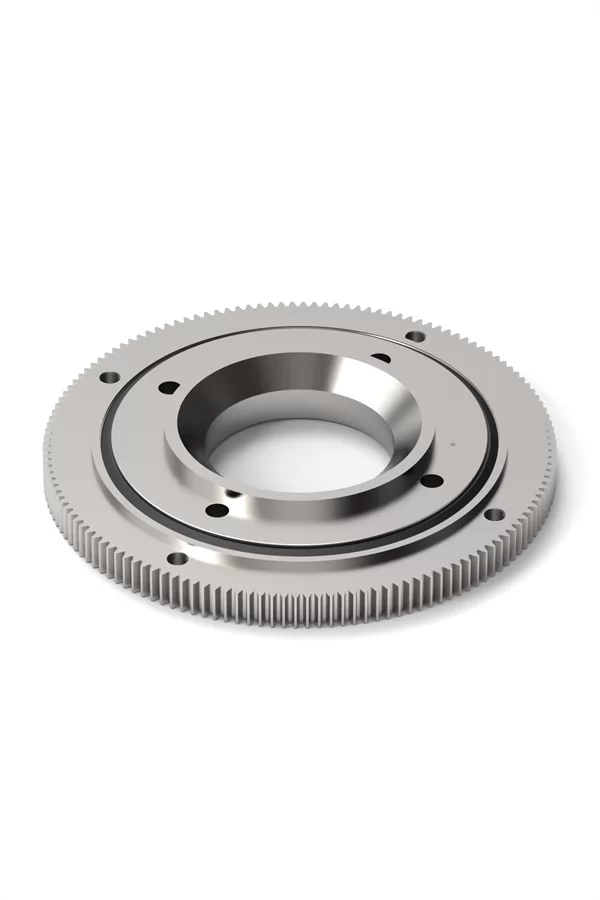
External gear slewing bearings have teeth machined on the outer ring, driven by a pinion mounted outside the bearing circle. Internal gear bearings have teeth on the inner ring bore, with the drive pinion located inside the bearing, providing a more compact envelope with the gear protected from external contamination. Ungeared slewing bearings omit the gear ring entirely and are driven by a separate mechanism such as a friction drive, belt, or direct motor coupling. The choice depends on the drive arrangement, available space, and whether the gear needs to be enclosed within the slewing circle.
How does a slewing bearing differ from a standard rolling bearing?
A standard rolling bearing (deep groove ball, tapered roller, etc.) is designed primarily for radial or axial load in a shaft-and-housing arrangement. A slewing bearing is a large-diameter, thin-section bearing designed to carry simultaneous axial, radial, and overturning moment loads while supporting a rotating structure. Slewing bearings mount via bolt holes on both inner and outer rings (rather than press-fit on a shaft), and can incorporate a gear ring for driven rotation. They replace what would otherwise require multiple separate bearings in a complex structural arrangement.
What maintenance does a slewing bearing require?
Slewing bearings require periodic relubrication through grease fittings connected to internal distribution channels. The relubrication interval depends on operating conditions, load, speed, and environment. Bolt torque on the mounting fasteners should be checked periodically, as cyclic loading can cause gradual loosening. Seal condition should be inspected to ensure lubricant retention and contamination exclusion. For geared bearings, the gear mesh condition and backlash should be monitored. Consult BOM's engineering team for application-specific maintenance intervals.
Can BOM manufacture custom slewing bearings with specific gear parameters or non-standard dimensions?
Yes. BOM manufactures custom slewing bearings with application-specific gear module, tooth count, and pressure angle to match existing drive systems; custom bore, outer diameter, and height for proprietary equipment envelopes; non-standard bolt patterns and mounting interfaces; and alternative materials and surface treatments for specific operating environments. Contact BOM's engineering team with your dimensional envelope, load requirements, and drive system details to initiate a custom specification.
0 Comments
Share your thoughts
Showing 6
of 0
reviews
Your rating
Your review *
Your Name *
Enter your Name
Your Email *
Enter your Email
Submit
Contact Us
Get in Touch with Us
Name can't be empty
Email error!
Message can't be empty
error
Send Your Message